In the rarefied world of haute couture, where a single garment can command prices rivaling luxury automobiles, few materials demand as much reverence - or as many painstaking hours - as the humble feather. What appears as ethereal lightness on the runway represents thousands of hours of meticulous craftsmanship, a secret alchemy transforming nature's plumage into wearable art.
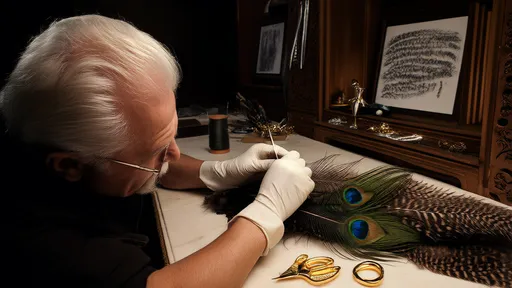
The ateliers of Paris and Milan guard these feather-working techniques with medieval guild-like secrecy. Master plumassiers - the official title for feather workers - train for decades to achieve the necessary precision. Their tools remain remarkably unchanged since the 19th century: tiny surgical scissors, tweezers finer than those used by watchmakers, and adhesives formulated to outlast the wearer without damaging delicate barbules.
Selection constitutes the first sacred ritual. Not every peacock eye or marabou plume meets exacting couture standards. Specialists comb through thousands of feathers under magnifying lamps, rejecting those with microscopic imperfections invisible to lay observers. The curvature of a heron's neck feather must match its destined position on a bodice; the iridescence of hummingbird feathers requires perfect angular alignment to catch light.
What follows resembles a slow-motion ballet of fingers and forceps. Down must be hand-cleaned strand by strand, removing particulate matter without disturbing the natural oils that maintain loft. Ostrich plumes undergo individual curling with heated instruments at precise temperatures - too cool and the curl won't hold, too hot and the keratin burns. For the legendary "feather snow" effect on Dior's 2012 winter collection, artisans spent three weeks hand-plucking goose down to achieve uniform fluffiness.
The mathematics behind feather placement would humble architects. Couture houses employ specialists who calculate overlapping patterns to maintain fluid movement while ensuring coverage. A single mermaid skirt might require 3,000 feathers placed at exact 17-degree angles to create the desired wave effect. Chanel's legendary "feather waterfall" jackets consume nearly 400 hours solely on directional stitching to make feathers cascade like liquid.
Color treatment represents another frontier of artistry. While some designers insist on nature's palette, others demand impossible hues. Achieving a true scarlet on cock feathers without compromising flexibility took one maison seven years to perfect. The process involves a proprietary sequence of vegetable dyes, steam setting, and UV stabilization - all performed at controlled humidity levels to prevent quill distortion.
Perhaps most astonishing is the structural engineering hidden beneath delicate appearances. Feathers destined for sculptural pieces undergo a secret strengthening process where select barbs are reinforced with silk thread thinner than spiderweb. This allows constructions like Schiaparelli's famous feathered bustier to maintain razor-sharp contours despite containing over 2,000 individual plumage elements.
The human cost becomes evident when examining exceptional pieces. A single feathered cape in Alexander McQueen's final collection consumed 1,900 work hours - nearly a full year for one artisan. Included in that count: 47 hours just to sort feathers by directional grain, 120 hours for hand-dyeing in graduated tones, and 83 hours practicing placement on a dummy before touching fabric. This doesn't account for the three prior years spent developing the specialized adhesive that could withstand runway lights without yellowing.
Modern technology has done little to accelerate these processes. Lasers burn feathers, 3D printers cannot replicate barbule structures, and even AI-assisted design falters when predicting how feathers will interact with air currents during movement. The 2018 collaboration between a robotics lab and a Parisian maison produced comically stiff results - feathers demand the nuanced pressure of human fingertips.
Ethical concerns have reshaped sourcing without simplifying craftsmanship. While endangered species feathers have disappeared from collections, the shift to farmed and molted plumage introduces new complexities. Ethical ostrich feathers require sorting through 30% more material to find perfect matches, as farm conditions create subtle variations in fiber structure. Some houses now employ full-time biologists to oversee avian welfare at partner farms.
The fragility of these creations renders them nearly unwearable outside controlled environments. Humidity makes feathers droop, wind disrupts carefully calibrated arrangements, and even prolonged exposure to stage lighting can alter hues. Clients purchasing feathered couture essentially acquire wearable museum pieces - most pieces undergo conservation treatments between outings, stored in argon-filled cases with humidity monitors.
Why persist with such an impractical art form? The answer lies in that magical moment when a feathered gown catches light and motion simultaneously, creating living chiaroscuro no fabric can replicate. As one retired plumassier noted while displaying a single perfect feather rose that took her a month to create: "We don't dress bodies, we give flight to dreams." In an era of mass production, that dream remains worth 2,000 hours of devotion.
The next time you see feathers gracing a couture runway, look closer. Those effortless swirls represent more cumulative human attention than the construction of a Gothic cathedral's rose window. Each quill positioned not just for beauty, but to respond perfectly to its wearer's breath - the ultimate marriage of nature's genius and human perseverance.

By /Aug 13, 2025

By /Aug 13, 2025

By /Aug 13, 2025

By /Aug 13, 2025

By /Aug 13, 2025

By /Aug 13, 2025

By /Aug 13, 2025

By /Aug 13, 2025

By /Aug 13, 2025

By /Aug 13, 2025

By /Aug 13, 2025
By /Aug 13, 2025
By /Aug 13, 2025
By /Aug 13, 2025

By /Aug 13, 2025
By /Aug 13, 2025
By /Aug 13, 2025
By /Aug 13, 2025

By /Aug 13, 2025
By /Aug 13, 2025
