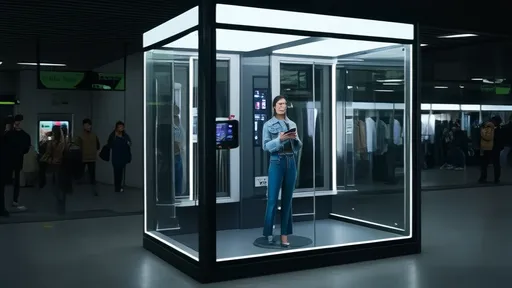
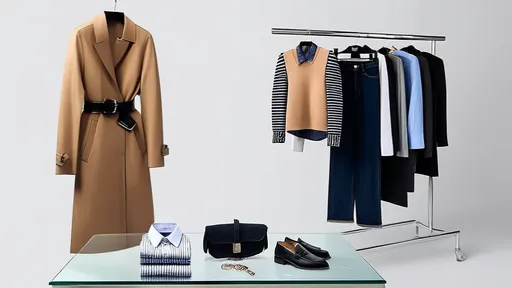
The morning commute just got a lot more stylish. Across major metropolitan subway stations, a new wave of interactive AR fitting kiosks is transforming bland transit corridors into vibrant virtual storefronts. These floor-to-ceiling digital installations aren’t just eye candy—they’re rewriting the rules of impulse shopping by letting passengers "try on" everything from limited-edition sneakers to statement coats without breaking stride.
Beneath the flickering LED lights of Tokyo’s Shinjuku Station, salarymen pause mid-stride as their reflections morph on the glass. The mirror suddenly drapes them in a tailored suit from a nearby department store, complete with dynamic fabric simulation that shows how the material would move during their walk to the office. This isn’t some sci-fi fantasy—it’s the new normal at Uniqlo’s AR Style Stations, where commuters can scan a QR code to have their virtual outfit waiting at the physical store before lunch.
The technology leverages advanced skeletal mapping algorithms that work in milliseconds, accounting for body proportions most shoppers wouldn’t notice until a garment disappoints in the fitting room. "We’ve eliminated the ‘hanger effect’," explains Dr. Elena Petrova, whose computer vision startup powers several European installations. "When someone sees how a jacket falls on their actual shoulders rather than a 3D model, conversion rates jump 40%."
New York’s MTA has taken a different approach with their #SubwayShop initiative. Instead of replicating traditional apparel racks, their kiosks feature location-exclusive digital merchandise. A Brooklyn-bound traveler might "try on" limited-release Yankees caps with augmented reality animations showing the embroidery details up close, while downtown passengers access Wall Street-inspired tie collections with real-time stock ticker patterns woven into the silk.
Privacy concerns melt away through clever engineering. The systems process all camera data locally, deleting body metrics within seconds after generating the virtual try-on. No facial recognition is employed—just anonymous body measurements that evaporate like morning mist. "It’s like having a personal stylist with absolute amnesia," quips Marcus Lee, a regular user at London’s Waterloo Station kiosks.
The psychological impact is profound. Behavioral economists note that the endowment effect—where people value items more highly once they "own" them—kicks in powerfully during these micro-interactions. When passengers see themselves wearing virtual items, even briefly, neural pathways fire as if the clothing is already theirs. Retailers report that this ephemeral ownership experience drives more post-commute store visits than traditional digital ads ever could.
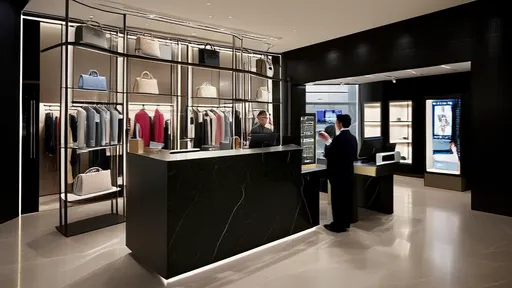
Parisian luxury houses have elevated the concept into an art form. At Châtelet–Les Halles station, commuters encounter Dior’s spectral atelier—a kiosk where their reflection gradually transforms as they walk past, first showing how a handbag would complement their stride, then layering accessories in real-time. The system remembers frequent users’ style preferences through opt-in profiles, creating a runway experience that changes with the seasons.
Behind the glass, machine learning works overtime. The kiosks constantly refine their recommendations based on aggregate data—if dozens of passengers in a financial district unconsciously linger on navy blazers every Monday morning, the system surfaces similar options. This ambient commerce creates what analysts call "the serendipity of algorithms," where tech facilitates discoveries that feel personally curated rather than digitally forced.
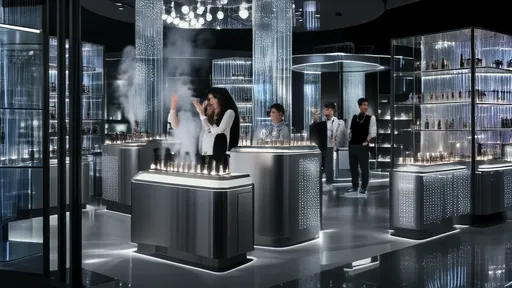
Not all innovations focus on apparel. Seoul’s subway AR kiosks recently introduced virtual makeup trials, using subway lighting conditions to show how foundations would appear in office fluorescents or evening restaurant lighting. The feature became so popular that cosmetics brands now release subway-exclusive shades, creating a new kind of underground beauty culture.
The installations are evolving beyond passive displays. At select stations in Milan, gesture recognition lets users adjust virtual garment fits with hand motions—pinching sleeves to slim them or pulling lapels to see different collar styles. This tactile dimension bridges the gap between digital convenience and the irreplaceable human desire to interact with materials, however virtually.
As the sun sets over Chicago’s Loop, a construction worker admires how steel-toe boots look on his mirrored avatar. The kiosk suggests moisture-wicking socks based on his foot size and local weather. Nearby, a lawyer tests how a briefcase would balance on her shoulder during crowded transfers. In this democratized space, luxury and utility coexist seamlessly—proving that the future of retail isn’t just about selling products, but about weaving commerce into the fabric of everyday journeys.
By /Aug 13, 2025

By /Aug 13, 2025
By /Aug 13, 2025
By /Aug 13, 2025
By /Aug 13, 2025

By /Aug 13, 2025
By /Aug 13, 2025

By /Aug 13, 2025
By /Aug 13, 2025
By /Aug 13, 2025
By /Aug 13, 2025
By /Aug 13, 2025

By /Aug 13, 2025

By /Aug 13, 2025

By /Aug 13, 2025
By /Aug 13, 2025

By /Aug 13, 2025

By /Aug 13, 2025
By /Aug 13, 2025

By /Aug 13, 2025
